API-First Development: Why It's No Longer Optional for Modern SaaS
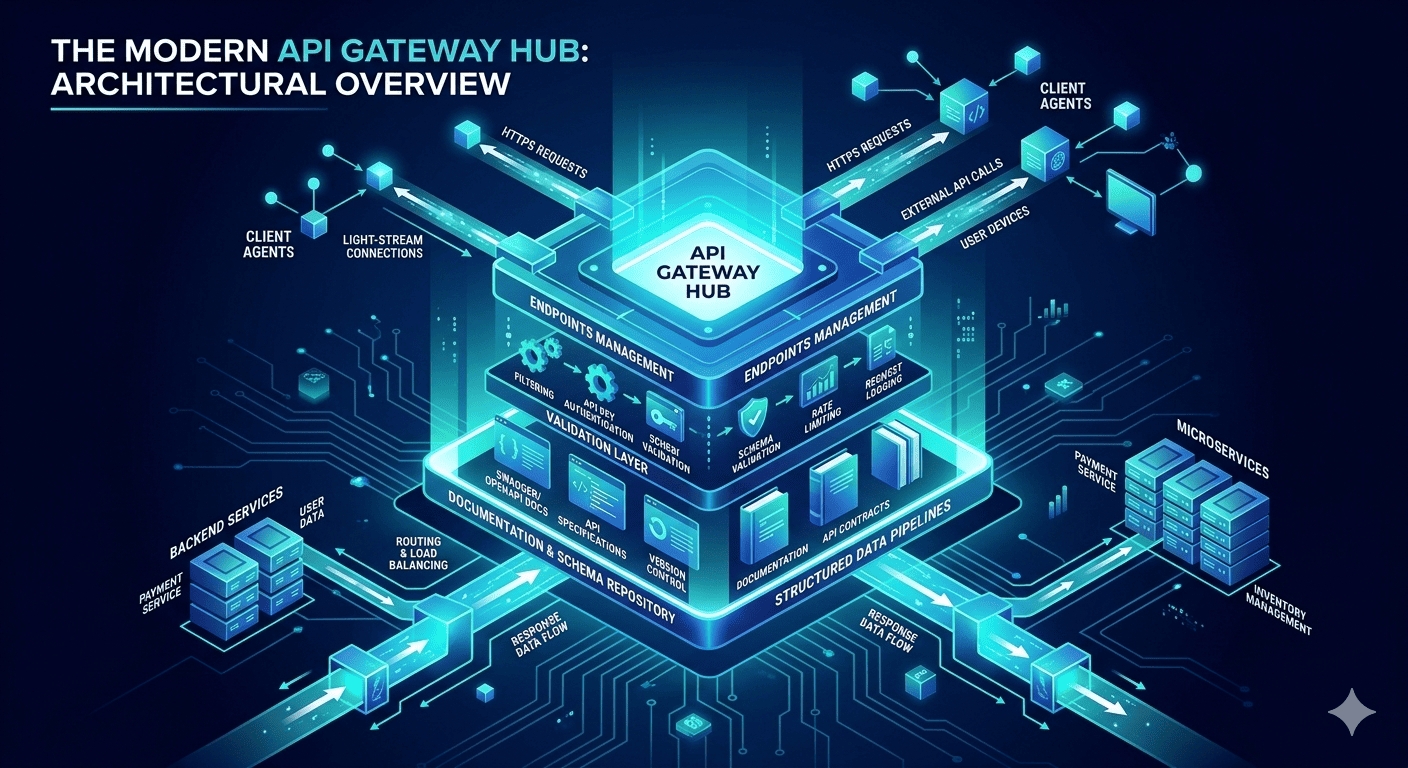
In the agentic AI era, API-first architecture isn't a best practice — it's survival. Here's why every SaaS product needs to be built for autonomous agents from day one.
The shift to agentic AI isn't just changing how businesses operate. It's fundamentally rewriting the rules of software architecture.
APIs aren't nice-to-have anymore. They're the primary interface.
In 2026, autonomous agents don't "use" your SaaS product by clicking buttons in a UI. They orchestrate your product by calling your APIs directly. Your sales agent books meetings through your API. Your support agent updates tickets through your API. Your analytics agent pulls usage data through your API.
If your APIs aren't production-grade, your entire agentic strategy collapses.
The Agent-First Reality
Modern SaaS architecture flows like this:
Human User → React/Vue UI → API Gateway → Backend Services
↓
Agent User → API Gateway → Backend Services
Notice what's missing for agents? The entire frontend layer.
Agent-ready APIs must deliver:
Structured JSON responses (no HTML scraping)
Predictable endpoints (REST or GraphQL, not ad-hoc)
Authentication (OAuth2/JWT, not session cookies)
Rate limiting (fair usage for high-volume agents)
Pagination (agents process thousands of records)
Webhooks (push events to agent workflows)
The Death of UI-First Development
Traditional SaaS built UIs first, APIs second. This worked when humans were the only users. Now it's backwards.
UI-First Problems:
1. Backend designed around screen layouts
2. APIs hacked together from frontend needs
3. Documentation extracted from code (incomplete)
4. Agent integration requires custom endpoints
5. Breaking changes ripple through UI + agents
API-First Solution:
1. Backend designed around business logic
2. UI built as API consumer #1
3. Agent built as API consumer #2
4. OpenAPI docs generated automatically
5. Changes validated against API contract
The Modern API Stack (Production-Ready)
Here's what we deploy at SingularRarity for every client project:
[FastAPI Backend] → [Postgres + Redis] → [Agent Tools]
↓ ↓ ↓
[OpenAPI Docs] [Automatic Clients] [Agent Registry]
Critical layers:
1. FastAPI (Python) — typed endpoints, auto-docs
2. Pydantic — request/response validation
3. SQLAlchemy + Alembic — database migrations
4. Redis — caching + rate limiting
5. Prometheus — agent usage monitoring
Real-World Agent API Patterns
Lead Management System:
POST /leads/search → {industry: "AI", min_revenue: 1e6}
GET /leads/{id}/enrich → {company_data, contact_info}
POST /leads/{id}/outreach → {email_template, schedule}
Customer Support:
POST /tickets → {customer_id, issue_category}
GET /tickets/{id}/conversation → full thread history
POST /tickets/{id}/escalate → {agent: "human", priority: "high"}
Analytics Dashboard:
POST /reports/generate → {metrics: ["mrr", "churn"], timeframe: "30d"}
GET /reports/{id}/status → {progress: 85, eta: "2m"}
GET /reports/{id}/download → streaming CSV/JSON
The OpenAPI Contract
Every production API starts with OpenAPI 3.1 specification:
paths:
/leads:
post:
summary: Create new lead
requestBody:
content:
application/json:
schema:
type: object
required: [email, company]
responses:
'201':
content:
application/json:
schema:
$ref: '#/components/schemas/Lead'
Why this matters for agents:
Zero custom integration — auto-generate client code
Type safety — Pydantic validates every request/response
Interactive docs — agents can explore endpoints
Contract testing — changes can't break consumers
Security for Agent Workloads
Agents call APIs at scale, so security must be bulletproof:
1. JWT + RBAC — per-agent permissions
2. Rate limiting — 1000 req/min per agent
3. Input validation — Pydantic schemas block injection
4. Audit logging — every agent action traceable
5. Webhook verification — HMAC signatures
The Migration Path
For existing SaaS products:
Week 1: Audit current endpoints → OpenAPI spec
Week 2: Add Pydantic validation + auth layer
Week 3: Build agent-specific endpoints
Week 4: Deploy API gateway + docs
For greenfield projects:
Start with the API spec. Build UI as consumer #1. Agents consume immediately.
Business Impact
API-first companies win because:
Agent marketplaces emerge — your API becomes a building block
Internal leverage — every team builds agents against your APIs
Partner ecosystem — clean APIs = easy integrations
Exit multiple — acquirers value API-ready infrastructure
The Bottom Line
Your competitors are still perfecting their React components. You're building the API layer that autonomous agents will orchestrate across your entire business.
At SingularRarity Labs, every project starts with the API contract — because we know agents will be your primary users within 12 months.
Ready to future-proof your SaaS architecture? Let's audit your current endpoints.
SingularRarity Labs builds what others can't imagine — where singular ideas become rare realities.
Tags