Engineering Elite Digital Experiences: SingularRarity's Development Philosophy
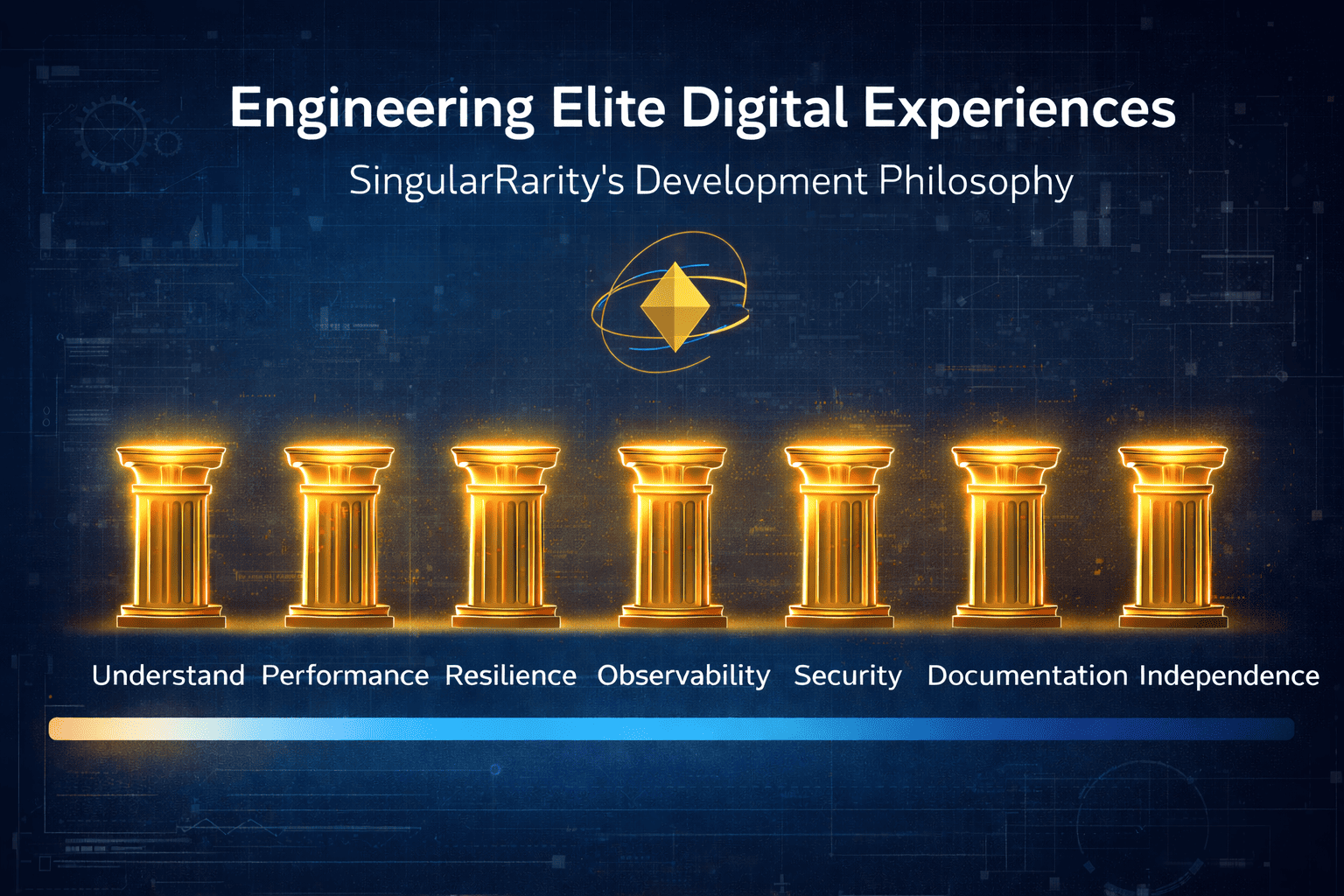
What separates forgettable software from elite digital experiences? SingularRarity Labs breaks down the 7 engineering principles behind every product we build.
"Good enough" software ships. Elite software compounds.
The difference between a product clients tolerate and one they evangelize isn't a bigger budget or a larger team. It's a set of non-negotiable engineering principles applied consistently from discovery through deployment.
At SingularRarity Labs, these principles aren't aspirational — they're contractual. Here's exactly what we mean by elite digital experiences and how we engineer them.
Principle 1: Understand Before You Build
Most agencies begin writing code before they understand the problem. We begin by mapping the problem before touching a keyboard.
What we map before Day 1 of development:
├── User mental models (how users think, not how devs think)
├── Failure paths (what happens when it breaks)
├── Edge cases (the 20% that causes 80% of support tickets)
├── Integration realities (every third-party API is a liability)
└── Growth trajectory (what does 10x scale demand?)
Why this matters:
Features built without this understanding: Technical debt
Features built with this understanding: Competitive moats
Cost of fixing post-launch: 100x cost of fixing pre-build
Principle 2: Performance Is a Feature
Users leave at 3 seconds. Agents timeout at 5 seconds.
In 2026, your users are both humans and AI agents. Both have zero tolerance for slow systems. Performance isn't a nice-to-have — it's the difference between adoption and abandonment.
Our performance targets (non-negotiable):
API response: <200ms P95
Page load: <1.5s (LCP)
Database query: <50ms P99
Agent response: <800ms end-to-end
WebSocket latency: <100ms
How we achieve this:
# Async-first architecture (FastAPI)
@app.get("/leads/{lead_id}")
async def get_lead(lead_id: int, cache: Redis = Depends()):
    # Cache layer first
    if cached := await cache.get(f"lead:{lead_id}"):
        return cached

    # Parallel DB + enrichment fetch
    lead, enrichment = await asyncio.gather(
        db.get_lead(lead_id),
        enrichment_service.get(lead_id)
    )

    await cache.set(f"lead:{lead_id}", lead, ttl=300)
    return {**lead, **enrichment}
Principle 3: Design for Failure, Not Success
Every system fails. Elite systems fail gracefully.
Amateur engineering assumes the happy path. Elite engineering assumes Murphy's Law — API timeouts, database connection spikes, LLM rate limits, payment gateway outages.
Our resilience patterns:
Circuit Breaker:
├── 5 failures in 30s → Open circuit
├── 60s cooldown → Half-open probe
└── Success → Close circuit

Retry Logic:
├── Exponential backoff (1s, 2s, 4s, 8s)
├── Jitter (randomized to prevent thundering herd)
└── Max 3 retries → Dead letter queue

Graceful Degradation:
├── LLM down? → Template fallback
├── CRM down? → Queue + retry
└── Cache miss? → Direct DB (slower, never broken)
Principle 4: Observability Before Launch
You cannot fix what you cannot see.
Most agencies deploy and hope. We deploy and know — exactly which endpoint slowed, which database query ballooned, which agent failed, and why.
Production observability stack:
Metrics: Prometheus → Grafana dashboards
Logs: Structured JSON → Loki → Grafana
Traces: OpenTelemetry → Jaeger (full request traces)
Errors: Sentry (real-time, with context)
Uptime: UptimeRobot (₹0) + PagerDuty alerts
Dashboards we ship with every project:
Business Dashboard:
├── Revenue per API call
├── Lead conversion by segment
├── Agent success rate
└── Cost per transaction

Technical Dashboard:
├── P50/P95/P99 latency by endpoint
├── Error rate by service
├── DB connection pool usage
└── Cache hit ratio
Principle 5: Security Cannot Be Retrofitted
Security added after launch is security theatre.
Every SingularRarity project ships with security embedded from the first line of code — not audited in Week 12.
Security as architecture (not afterthought):
Data Layer:
├── Row Level Security (Postgres policies)
├── Field encryption (PII columns)
└── Connection TLS everywhere

API Layer:
├── JWT + fine-grained RBAC
├── Input validation (Pydantic — every endpoint)
└── Rate limiting (per-user, per-agent, per-IP)

Infrastructure:
├── Secrets in KeyVault (never in .env)
├── Container scanning (pre-deploy)
└── Network policies (zero trust)
Principle 6: Documentation Is Code
Undocumented systems decay immediately.
The most expensive moment in software is when the engineer who built it leaves. Elite systems document themselves — continuously, completely, and accurately.
What every SingularRarity delivery includes:
📘 Architecture Decision Records (why we chose X)
📗 OpenAPI + Postman (every endpoint, every schema)
📙 Runbooks (deploy, rollback, scale — step by step)
📕 Data dictionary (every table, every field, every relationship)
📓 Agent architecture (prompt templates, tool registry, flow diagrams)
📒 Onboarding guide (new engineer productive in 2 days)
Principle 7: Build to Be Replaced
The best system is one you can walk away from.
We build systems that don't need us to survive. Zero proprietary dependencies, zero vendor lock-in, zero "only we understand this codebase."
Independence guarantees:
✅ Open source stack only (FastAPI, Postgres, Redis)
✅ Git history from Day 1 (full context preserved)
✅ Infrastructure as code (rebuild from zero in 2 hours)
✅ Documented secrets rotation (no tribal knowledge)
✅ Architecture diagrams current at all times
✅ Exit-ready contracts (you own everything)
What This Looks Like in Practice
A client asked us once: "Why do you spend two weeks on discovery for a four-week build?"
Our answer: "Because the two weeks of discovery is what makes the four-week build possible. Without it, you get a six-month build and a support contract for life."
Elite engineering isn't slower. It's permanently faster:
Amateur timeline:
├── Build: 6 weeks
├── Fix production bugs: 12 weeks
├── Rewrite (scale issues): 6 months
└── Total: 9–10 months to stable product

SingularRarity timeline:
├── Discovery + Architecture: 3 weeks
├── Build: 8 weeks
├── QA + Deploy: 3 weeks
└── Total: 14 weeks to stable product
The 98% Satisfaction Number
Our 98% client satisfaction rate isn't a coincidence. It's the direct output of these 7 principles applied without compromise across every engagement — ₹5 Lakh pilots and ₹1 Cr enterprise systems alike.
What clients say consistently:
"First agency that asked about our failure modes."
"The documentation alone was worth the contract."
"6 months live, zero critical incidents."
"Our new CTO read the ADR and said it was the most thorough architecture doc he'd ever seen."
Working With SingularRarity
We take on a limited number of projects simultaneously — because every client deserves these 7 principles applied with full attention, not delegated to junior developers.
What this means for you:
✅ Senior engineers only (no outsourcing)
✅ One project manager throughout
✅ Direct access to lead architect
✅ Weekly demos (working software, not slides)
✅ Fixed price + timeline guarantee
If you want software that compounds value instead of creating debt, let's talk.
SingularRarity Labs builds what others can't imagine — where singular ideas become rare realities.
Tags