From Idea to Deployment — SingularRarity's 6-Phase Turnkey Project Delivery Framework
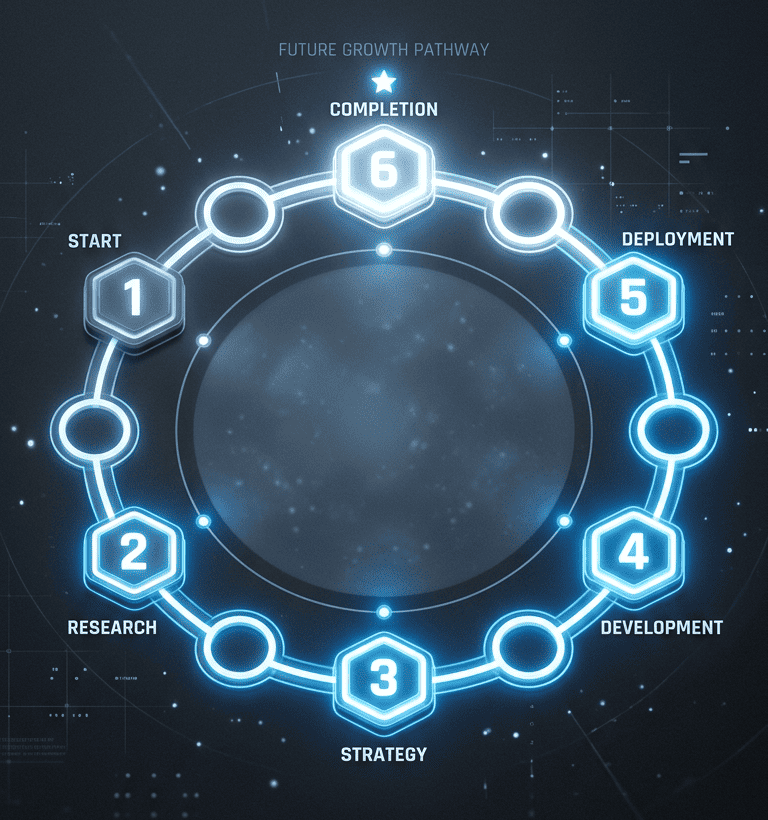
How does SingularRarity Labs deliver complex AI and software projects that others can't? Here's the exact 6-phase framework we use on every engagement.
"Turnkey" is one of the most overused words in software services. Every agency claims to offer it. Very few actually deliver it — a complete, working, production-ready system handed to you with full ownership, zero loose ends, and no surprise scope at the end.
At SingularRarity Labs, turnkey isn't a marketing term. It's a contractual commitment backed by a structured delivery framework we've refined across every type of digital and AI project. Here's exactly how we work.
Phase 1: Deep Discovery (Week 1–2)
Most project failures are rooted in a shallow discovery phase. We spend the first one to two weeks doing nothing but understanding your problem.
This means structured stakeholder interviews, mapping your existing tech stack and data flows, identifying integration points, surfacing hidden requirements, and stress-testing your assumptions. We produce a Discovery Document — a written record of what we understood, what we'll build, and what we intentionally won't build. You sign off on this before any architecture begins.
The Discovery Document is your protection as much as ours.
Phase 2: Architecture Design (Week 2–3)
With a clear problem definition, we design the system architecture. This is where technology decisions are made — which database, which framework, which AI model, which infrastructure, how services communicate, where security boundaries sit.
We produce an Architecture Decision Record (ADR) that explains not just what we chose, but why — including alternatives we considered and rejected. This document becomes part of your final handoff package.
Phase 3: Iterative Build (Week 3–8, varies by scope)
Development happens in short, visible sprints — typically one week each. At the end of every sprint, you see working software, not status reports.
We maintain a shared project board you have full access to. Every feature, bug, and decision is logged. You are never in the dark about where your project stands.
Code is reviewed internally before it reaches staging. We enforce testing coverage thresholds and run automated security scans on every build. Security is not a phase — it's woven into every sprint.
Phase 4: Integration & QA (Week 8–10)
Once core features are built, we move into end-to-end integration testing. This is where all the pieces connect — third-party APIs, your existing systems, edge case handling, load testing, and failure recovery.
This phase is where most agencies cut corners. We don't. An integration failure discovered in production is 10x more expensive than one caught in QA.
Phase 5: Staging Deployment & Client UAT (Week 10–11)
We deploy to a staging environment that mirrors production exactly. You and your team run User Acceptance Testing — using the real system, with real data, under realistic conditions.
We remain on-call during UAT to fix anything that surfaces. No issue discovered during UAT counts against your timeline — it counts against ours. That's how we stay aligned with your outcome.
Phase 6: Production Deployment & Handoff (Week 11–12)
Production deployment follows a written deployment runbook — no ad-hoc releases, no undocumented configuration changes. We monitor the live system for a defined period post-launch.
Handoff includes:
Complete technical documentation
Architecture diagrams
API reference documentation
Deployment and environment setup guides
A recorded walkthrough of the codebase
A 30-day post-launch support window
You walk away with a system you fully own and fully understand. You are never dependent on us to keep the lights on — though many clients choose to continue working with us because of the quality of the relationship built during delivery.
Why This Framework Exists
We built this process because we've seen what happens without it. Scope that balloons silently. Integrations that get "figured out later." Security that never gets added. Handoffs that leave clients with a codebase they can't touch.
The SingularRarity framework is designed so that even if the worst happens — timeline slips, a requirement changes, a third-party API is deprecated mid-build — there are no surprises and no excuses. Just a clear, documented path to a delivered product.
Where singular ideas become rare realities.
Ready to start? Reach out to us at info@singularraritylabs.com to schedule a discovery conversation. We take on a limited number of projects at a time — because every client deserves our full attention.
SingularRarity Labs builds what others can't imagine — where singular ideas become rare realities.