Microservices vs. Monolith in 2026: Which Architecture Is Right for Your Product?
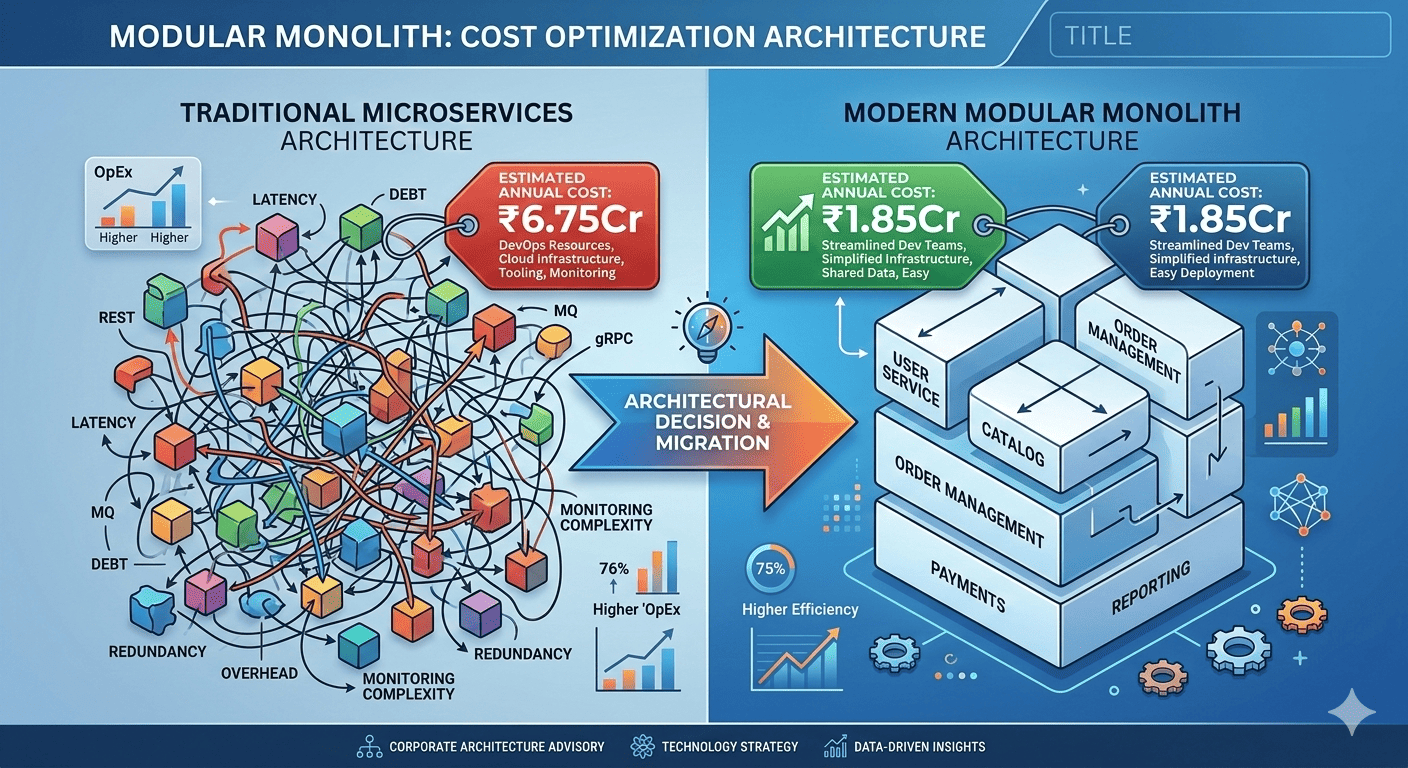
85% of enterprises use microservices — yet 42% are consolidating back. Here's the real data-backed decision framework for 2026 from CNCF, Amazon, and Martin Fowler.
Microservices dominate enterprise architecture — 85% of large organizations run them (Solo.io, 2025). But a quiet rebellion is happening: 42% of companies that adopted microservices are now consolidating back to simpler architectures, per the CNCF Annual Survey 2025.
Not because microservices failed. Because most teams never needed them in the first place.
The winner for 90% of SaaS products in 2026? Modular Monolith — the architecture that delivers microservices' benefits at a fraction of the cost and complexity.
The Real Numbers (2025–2026 Industry Data)
Microservices adoption:
85% of enterprises use microservices (Solo.io, 2025)
77% of organizations adopted microservices (O'Reilly, 2025)
80% of teams run Kubernetes in production (CNCF, 2025)
89% have adopted cloud-native technologies (CNCF, 2025)
The consolidation signal:
42% of microservices adopters are consolidating back (CNCF, 2025)
60% of teams regret microservices for small/mid apps (Gartner, 2025)
Service mesh adoption dropped from 18% → 8% in 2 years (CNCF, 2025)
Conclusion: Microservices are not dying — they're maturing. Enterprise-scale companies need them. Startups and SMBs almost never do.
The Amazon Prime Video Wake-Up Call
In 2023, Amazon published a case study that shook the architecture community: they migrated their Prime Video monitoring service from microservices back to a monolith and achieved a 90% cost reduction (Amazon Prime Video Tech Blog, 2023).
Before the myth spreads — Amazon's platform still runs thousands of microservices. What they eliminated was one internal high-throughput, low-latency workflow that was drowning in network overhead and AWS Step Functions costs (LinkedIn Engineering Analysis, 2026).
The lesson isn't "microservices are bad." It's: architecture must match context.
The 2026 Decision Framework
Martin Fowler coined the "Microservices Premium" — the productivity tax teams pay for distributed systems that only pays off in genuinely complex scenarios. The 2025 consensus data makes the thresholds concrete (byteiota.com, 2026):
<10 engineers → Modular Monolith wins decisively
10-50 engineers → Modular Monolith with module extraction
50+ engineers → Microservices benefits justify operational cost
$10M+ ARR → Microservices coordination costs break even
The Architecture Spectrum (What Actually Exists)
Spaghetti Monolith → Modular Monolith → Selective Microservices → Full Microservices
(avoid always)       (most teams)        (50+ engineers)           (Netflix/Uber)
Team size math:
Microservices require 3–5 engineers per service to maintain properly. A 15-person team managing 12 services spends more time on infrastructure than building features. (byteiota.com, 2025)
The Modular Monolith: What It Actually Looks Like
Not spaghetti code. Not a big ball of mud. Hard module boundaries with independent deployment capability.
[FastAPI App]
├── /auth/ (module)     → auth.db (isolated)
├── /leads/ (module)    → leads.db (isolated)
├── /billing/ (module)  → billing.db (isolated)
├── /reports/ (module)  → analytics.db (isolated)
└── Shared kernel       → Redis cache (read-only)
Module boundaries (non-negotiable):
# leads/module.py
from module import ModuleRouter

leads_router = ModuleRouter("leads")

@leads_router.get("/search")
def search_leads(q: str):
    # Isolated DB connection — no cross-module queries
    return leads_db.search(q)
Key rules:
No circular dependencies between modules
No foreign key relationships across module databases
Event-driven sync via internal message queue
Each module deployable independently
Cost Reality (₹ Crore/Year)
Per Jellyfish Technologies Architecture Cost Analysis, 2025:
Modular Monolith (5 engineers):
├── Engineer salaries: ₹1.25 Cr/year
├── Infra (Docker + single VPS): ₹60 Lakh/year
└── Total: ₹1.85 Cr/year

Full Microservices (15 engineers):
├── Engineer salaries: ₹3.75 Cr/year
├── Infra (Kubernetes + service mesh): ₹2.4 Cr/year
├── DevOps tooling (Istio, Jaeger, Kong): ₹60 Lakh/year
└── Total: ₹6.75 Cr/year

Difference: ₹4.9 Cr/year for same business outcome
Microservices Consolidation Warning Signs
Per CNCF 2025 Annual Survey, the signs your microservices are over-engineered:
❌ Services deploy together always → Remove the boundary
❌ Services scale together always → Combine them
❌ Services fail together always → No isolation benefit
❌ Owned by the same team → No coordination benefit
❌ Sub-10 engineers managing 10+ services → Drowning
When Microservices Are Genuinely Right
✅ 50+ engineers across multiple product teams
✅ $10M+ ARR with proven scaling bottlenecks
✅ Measured performance data demands isolation
✅ Compliance requires physical separation
✅ Different technology stacks per team
✅ Multi-region independent deployments
The Migration Path (Forward, Not Backwards)
Per Scalosoft Architecture Guide, 2025:
Start here → evolve only when real constraints demand it:
Phase 1: Modular Monolith (₹25 Lakh, 3 months)
→ Extract modules with clean boundaries
→ Database-per-module
→ Independent deployments

Phase 2: Surgical Extraction (₹1.5 Cr, 12 months)
→ Extract highest-traffic modules only
→ When measured data justifies it

Phase 3: Full Microservices (₹4 Cr+, 24 months)
→ Only when team >50 engineers
→ Only when $10M+ ARR
The 2026 Bottom Line
Microservices are not dead — Netflix, Amazon, Uber still run thousands of them. But "modern" doesn't mean "distributed." It means choosing what's effective for your specific context. (CNCF 2025 Consolidation Report)
For 95% of SingularRarity Labs' client base — startups, SMBs, scaling SaaS — modular monolith is the correct default. We evolve architecture surgically when measured data demands it, not when architecture trends demand it.
Save ₹4.9 Cr/year. Ship 3x faster. Scale confidently when you actually need to.
Ready to audit your architecture with our decision matrix?
SingularRarity Labs builds what others can't imagine — where singular ideas become rare realities.
Tags