Multi-Agent Orchestration: The Microservices Moment for AI
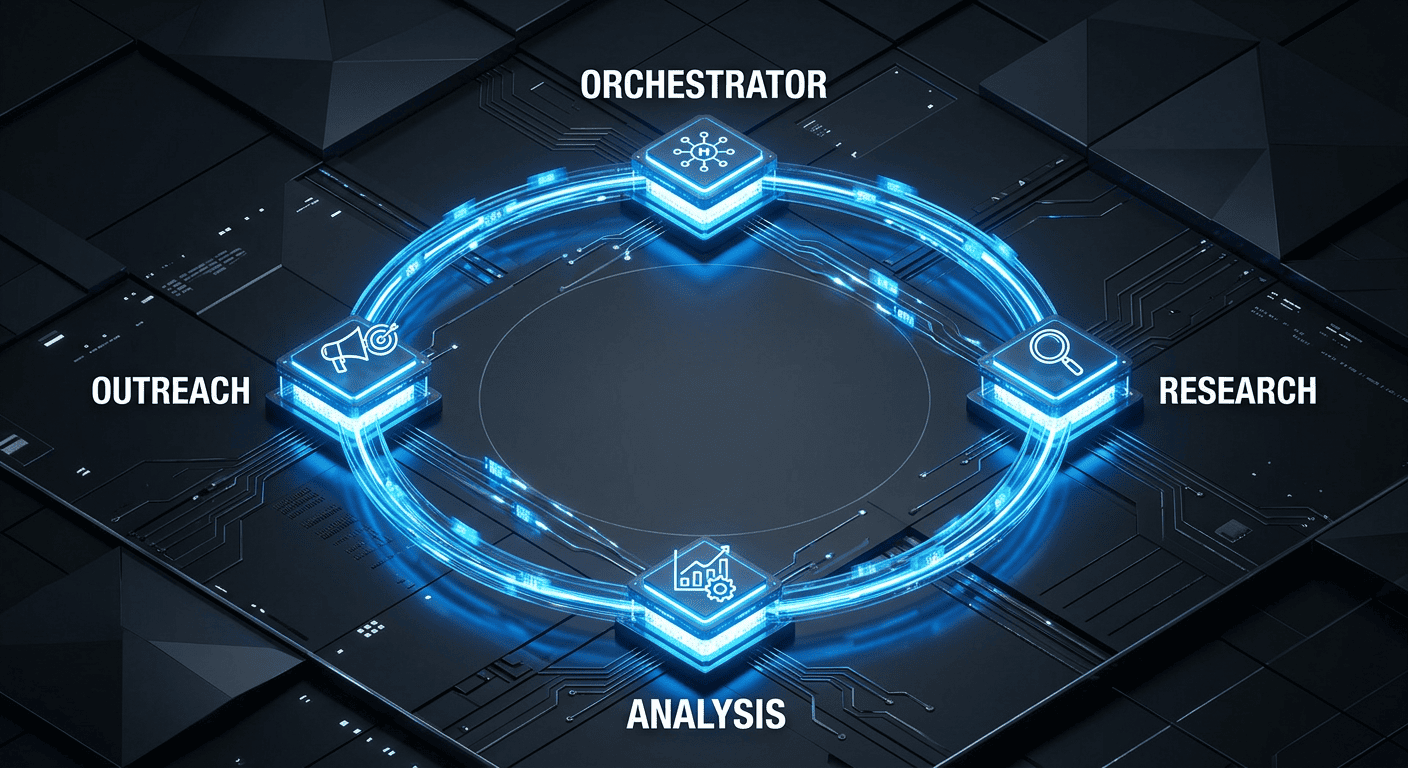
Single AI agents are powerful, but multi-agent systems are transformative. Here's how agent teams work together like microservices — and why your business needs them now.
Single AI agents can write code, answer questions, or analyze data. But what happens when you need something more complex — like a complete lead generation pipeline, a customer support escalation system, or an autonomous research team?
The answer is multi-agent orchestration — the moment AI went from powerful tool to complete operational system. It's the microservices revolution for intelligence.
What Are Multi-Agent Systems?
Think of traditional AI as a single employee who can do many things reasonably well. Multi-agent systems are like specialized teams where each agent has a single, narrow focus and excels at it completely.
Research Agent — finds prospects, scrapes websites, extracts contact info
Analysis Agent — scores leads, segments by industry, predicts buying signals
Outreach Agent — crafts personalized emails, schedules follow-ups
Orchestrator Agent — manages handoffs, resolves conflicts, tracks progress
Each agent is small, focused, and replaceable. The system as a whole becomes more capable than any single agent could be.
The Microservices Parallel
If you've worked with modern software architecture, this pattern will feel familiar:
Traditional Monolith | Single Agent | Microservices | Multi-Agent System |
|---|---|---|---|
One big app | One big model | Small services | Small specialized agents |
Hard to scale | Prompt limits | Independent scaling | Scale agents separately |
Single failure = total failure | One hallucination breaks everything | Isolated failures | Graceful degradation |
Hard to update | Locked to one model | Update services independently | Swap agents/models |
Multi-agent systems inherit all the benefits that made microservices dominant in software engineering.
Why Multi-Agent Systems Win
1. Specialization beats generalization
A research agent tuned specifically for finding B2B contact info will outperform a general-purpose model 10x. Same principle applies across every role.
2. Cost efficiency through modularity
Swap out the research agent for a cheaper/faster model without touching the rest of the system. Scale the expensive analysis agent only during peak hours.
3. Resilience through redundancy
If one agent hallucinates or fails, others continue. The orchestrator reroutes work automatically.
4. Rapid iteration
Test new agent configurations independently. A/B test outreach strategies without disrupting research.
Real-World Multi-Agent Applications
Complete Lead Generation Pipeline
Orchestrator → Research Agent → Enrichment Agent →
Analysis Agent → Outreach Agent → Follow-up Agent
Customer Support Escalation
Triage Agent → Technical Support Agent →
Billing Agent → Escalation Agent → Human Handoff
Autonomous Research Teams
Query Agent → Source Evaluation Agent →
Data Extraction Agent → Synthesis Agent → Report Agent
The Orchestration Layer: Where It All Connects
The magic happens in the orchestrator — a lightweight coordination layer that:
Assigns tasks to the right agent based on context
Manages memory and state across the entire workflow
Handles retries, timeouts, and error recovery
Tracks costs and performance metrics
Makes dynamic routing decisions
Modern frameworks like LangGraph, CrewAI, and AutoGen make this orchestration layer production-ready today.
Technical Implementation at SingularRarity
We typically build multi-agent systems following this architecture:
[Client Goal] → [Orchestrator] → [Agent Team]
↕
[Shared Memory] + [Tool Registry]
Key components:
FastAPI backend for the orchestrator (your stack)
Redis/Postgres for shared memory and state
LangChain/LangGraph for agent coordination
Custom tools for your specific domain (CRM APIs, research scrapers, etc.)
Business Impact
Multi-agent systems don't just save time — they create entirely new capabilities:
Replace entire teams with agent orchestrations (outbound sales, support tier 1)
Operate 24/7 across timezones without hiring
Learn and adapt as business rules change
Scale infinitely without proportional cost increases
Getting Started
The good news: you don't need a massive AI team to build this. A single senior engineer can deliver a production multi-agent system in 4–6 weeks using existing frameworks.
The bad news: most "AI agencies" still build single-model chatbots and call it agentic AI. True multi-
agent orchestration requires architectural thinking beyond prompt engineering.
At SingularRarity Labs, we've delivered production multi-agent systems for lead generation, customer support, and internal operations. If you want to explore what a specialized agent team could do for your specific use case, let's have a conversation.
SingularRarity Labs builds what others can't imagine — where singular ideas become rare realities.
Tags