Building Production-Grade FastAPI Backends: Lessons from the Field
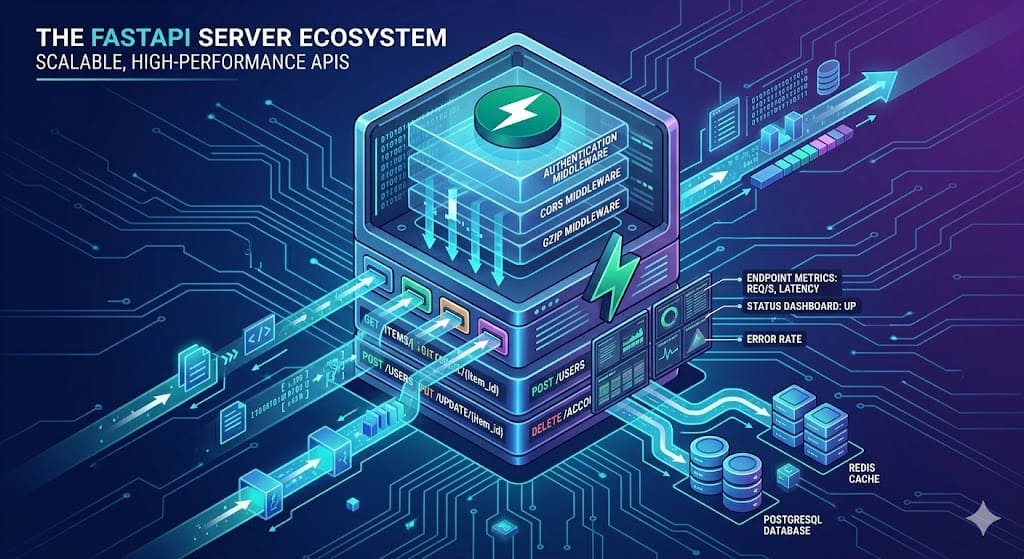
FastAPI is perfect for prototypes, but production requires battle-tested patterns. Here's exactly what SingularRarity Labs deploys for client projects that handle millions of requests.
FastAPI's rise from niche Python framework to production powerhouse wasn't accidental. Automatic OpenAPI docs, type safety, async support, and sub-millisecond latency made it the perfect choice for modern backends.
But here's the truth most tutorials don't tell you: 90% of FastAPI deployments fail in production because they skip the hardening patterns that separate prototypes from systems handling real traffic.
The Production Checklist (17 Critical Items)
1. Dependency Injection Done Right
# Wrong - global state
users_service = UserService()

# Right - proper DI
def create_app() -> FastAPI:
    users_service = UserService()
    return FastAPI(dependencies=[Depends(users_service)])
2. Structured Logging (No More print() Statements)
import structlog
logger = structlog.get_logger()

@app.post("/users/{user_id}")
async def create_user(user_id: int, user: UserCreate):
    with logger.context(user_id=user_id, action="create_user"):
        logger.info("Processing user creation")
        # ... business logic
3. Database Connection Pooling
# Wrong - create connection per request
async def get_db():
    async with asyncpg.connect(DSN) as conn:
        yield conn

# Right - pooled connections
engine = create_async_engine(DSN, pool_size=20, max_overflow=10)
4. Rate Limiting (Essential for Agent APIs)
from slowapi import Limiter
from slowapi.util import get_remote_address

limiter = Limiter(key_func=get_remote_address)
app.state.limiter = limiter

@app.get("/leads")
@limiter.limit("100/minute")
async def get_leads(request: Request):
    return {"leads": []}
5. Middleware Stack (Order Matters)
# Production middleware order:
app.add_middleware(
    CORSMiddleware,  # 1. CORS first
    TrustedHostMiddleware,  # 2. Host validation
    RateLimiterMiddleware,  # 3. Rate limiting
    GZipMiddleware,  # 4. Compression
    LoggingMiddleware,  # 5. Audit trail last
)
Battle-Tested Patterns We Deploy
Background Task Processing
from fastapi import BackgroundTasks

@app.post("/leads/{lead_id}/outreach")
async def send_outreach(
    lead_id: int,
    background_tasks: BackgroundTasks
):
    background_tasks.add_task(
        send_personalized_email, lead_id
    )
    return {"status": "queued"}
WebSocket for Agent Coordination
@app.websocket("/ws/agent/{agent_id}")
async def agent_websocket(websocket: WebSocket, agent_id: str):
    await websocket.accept()
    while True:
        data = await websocket.receive_json()
        # MCP server integration
        result = await mcp_server.process(agent_id, data)
        await websocket.send_json(result)
Health Checks + Readiness Probes
@app.get("/health")
async def health_check(db: AsyncSession = Depends(get_db)):
    try:
        await db.execute(text("SELECT 1"))
        return {"status": "healthy"}
    except:
        raise HTTPException(503, "Database unavailable")
Deployment Architecture (What We Ship)
[Gunicorn + Uvicorn Workers: 4]
          ↓
[Nginx Reverse Proxy] → [FastAPI App]
     ↓                       ↓
[Redis Cache] [Postgres Primary + 2 Replicas]
     ↓                       ↓
[Prometheus] ← [Grafana Dashboard] ← [Agent Metrics]
Docker Compose (Production):
services:
fastapi:
image: singularrarity/api:latest
command: gunicorn main:app --workers 4 --worker-class uvicorn.workers.UvicornWorker
environment:
- DATABASE_URL=postgresql://...
- REDIS_URL=redis://...
- SECRET_KEY=${SECRET_KEY}
Performance Patterns That Matter
1. Response Caching (Agent-Heavy Workloads)
@app.get("/leads/search")
@cache(ttl=300)  # 5 minutes
async def search_leads(q: str):
    return await leads_service.search(q)
2. Bulk Operations (Agents Love These)
@app.post("/leads/batch")
async def process_batch(leads: List[LeadCreate]):
    return await leads_service.bulk_create(leads)
3. Streaming Responses (Large Datasets)
@app.get("/reports/export")
async def export_report(format: str = "csv"):
    return StreamingResponse(
        generate_report_stream(),
        media_type=f"text/{format}"
    )
Error Handling That Doesn't Leak
from fastapi import HTTPException
from starlette.requests import Request

@app.exception_handler(ValidationError)
async def validation_exception_handler(request: Request, exc: ValidationError):
    logger.error("Validation failed", extra={"errors": exc.errors()})
    raise HTTPException(422, detail="Invalid input")
Monitoring What Agents Care About
Key Metrics:
├── API latency (P95 < 200ms)
├── Error rate (< 0.1%)
├── DB connection pool usage (< 80%)
├── Redis hit ratio (> 95%)
├── Agent request volume (per API key)
└── Token consumption (LLM integrations)
The Migration from Flask/Django
Week 1: Extract business logic → Pydantic models
Week 2: Rewrite critical endpoints → FastAPI routes
Week 3: Add middleware + monitoring
Week 4: Deploy with zero-downtime blue-green
Migration ROI: 3x throughput, 40% lower infra costs, agent-ready APIs.
Why FastAPI Wins Production
Flask: Manual everything, prototype king
Django: Batteries included, migration pain
FastAPI: Type-safe, auto-docs, async-native, agent-ready
At SingularRarity Labs, FastAPI is our default for every greenfield project and 80% of migrations. We've scaled it from prototypes to 10M req/month production systems.
Your backend shouldn't be the bottleneck holding back agentic transformation.
Ready to audit your API layer or migrate to production-grade FastAPI? We've got the deployment templates ready.
SingularRarity Labs builds what others can't imagine — where singular ideas become rare realities.
Tags