Why 80% of Custom Software Projects Fail (And How We Ensure Yours Doesn't)
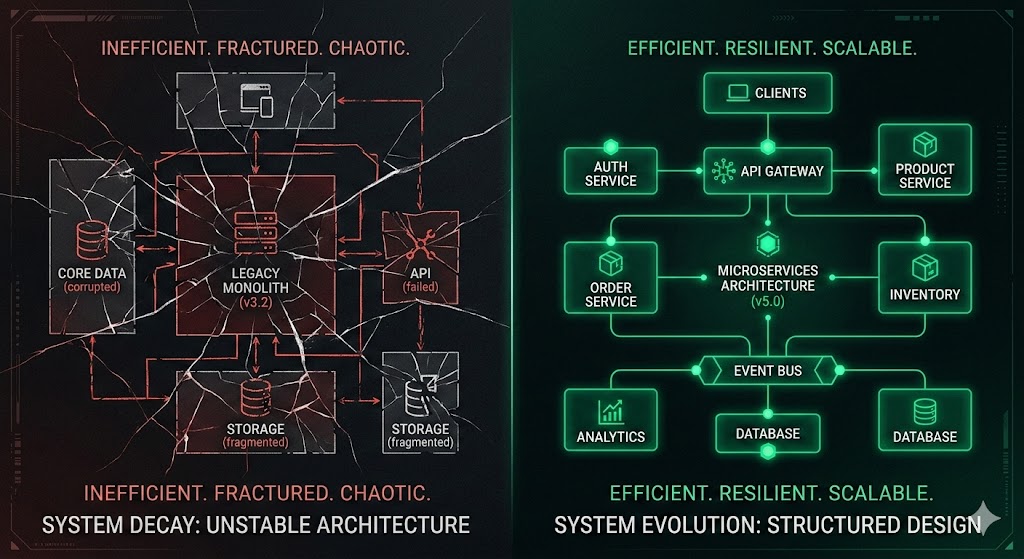
Most custom software projects run over budget, miss deadlines, or never ship. Here's why — and how SingularRarity Labs engineers differently.
If you've ever commissioned a custom software build, there's a good chance it didn't go as planned. Maybe it shipped six months late. Maybe the scope ballooned. Maybe it technically "launched" but never worked the way you envisioned.
You're not alone — and it's not entirely your fault.
The Brutal Statistics
Industry research consistently shows that a significant majority of custom software projects either miss their original deadline, exceed their budget, or fail to deliver the intended functionality entirely. The larger the project, the worse the odds.
But here's what's rarely said out loud: most of these failures are architectural, not technical. The code wasn't the problem. The thinking before the code was.
The 5 Root Causes of Failed Software Projects
1. Requirements captured too late — or not at all
Most agencies start building within days of a signed contract. The discovery phase — understanding what you actually need, not just what you asked for — is compressed or skipped entirely. The result: you get what you said, not what you meant.
2. Technology chosen for the vendor, not the problem
Many shops default to the same stack for every project because that's what their team knows. A fintech startup and a content platform do not have the same infrastructure needs — but they often get the same boilerplate backend.
3. No security layer until post-launch
Security is almost always bolted on at the end, if at all. This is the equivalent of designing a building and adding fire exits as an afterthought. A single breach after launch can cost more than the entire development budget.
4. No real ownership from the development side
When developers treat a project as a ticket queue rather than a product, edge cases get ignored, integrations get hacked together, and technical debt compounds silently until it collapses.
5. Handoff without documentation
Even when a project ships successfully, the client is often left with a codebase they can't maintain, extend, or hand to another developer without a complete rewrite.
The SingularRarity Approach
We built our delivery framework specifically to eliminate each of these failure points. Here's what that looks like in practice:
Deep discovery before a single line of code. We spend the first phase mapping your actual business logic, data flows, user journeys, and edge cases. We ask uncomfortable questions. We push back on assumptions. Because the most expensive bugs are the ones discovered in production.
Architecture chosen for your problem. Our team is fluent across microservices, monolithic, event-driven, and serverless architectures. We recommend what fits, not what's familiar.
Security-first by design. Every system we build embeds authentication, authorization, encryption, and input validation from day one — not as a patch.
Engineer ownership, not ticket execution. Every project at SingularRarity has an engineer who acts as a product owner — someone who thinks about your business outcome, not just the acceptance criteria.
Full documentation and knowledge transfer. We deliver every project with complete technical documentation, deployment guides, and a handoff session. You own what we build, fully.
What a Good Engagement Looks Like
A client comes to us with a problem: "We have a manual process that involves three different tools, a spreadsheet, and two people whose only job is to copy data between systems."
A bad agency builds them an app. We build them an intelligent, automated pipeline that eliminates the manual work, scales without hiring, and integrates cleanly with every tool they already use.
That's the difference between building software and solving a problem.
The 98% client satisfaction rate we maintain at SingularRarity isn't a marketing metric — it's a direct consequence of treating every project as if our name is on it. Because it is.
If your last software project didn't deliver what you needed, we'd like to show you what the process is supposed to feel like. Let's have a conversation.
SingularRarity Labs builds what others can't imagine — where singular ideas become rare realities.